Welcome to the World Cup
Every four years, the world comes to a standstill for a single sporting event. Businesses adjust schedules, schools pause lessons, and millions of people gather around televisions and phones to watch the same matches unfold. Few events command global attention on the scale of the FIFA World Cup.
The Format
The first ever 48 team World Cup. Twelve groups of four. The top two from each group, plus the eight best third place finishers, advance to a knockout Round of 32, producing a longer, broader tournament across three host nations.
The Groups
48 nations drawn into 12 groups of four. Hover any tile to see the full lineup. ★ marks host nations.
Group Standings
Live standings computed from played matches. Green = qualifies, gold = possible best third, grey = eliminated.
Every team is guaranteed a minimum of $12.5 million, made up of a $2.5 million preparation fee and $10 million for qualifying. Payouts then climb sharply with how far a nation advances, peaking at a record $50 million for the champions. Each team receives one payment based on the round it goes out in, not a running total.
| Finish | Per Team |
|---|---|
| Champions | $50M |
| Runners up | $33M |
| 3rd place | $29M |
| 4th place | $27M |
| Quarterfinals · 5th to 8th | $19M |
| Round of 16 · 9th to 16th | $15M |
| Round of 32 · 17th to 32nd | $11M |
| Group stage · 33rd to 48th | $9M |
PERFORMANCE PRIZE MONEY PER TEAM · PAID TO NATIONAL FEDERATIONS, NOT PLAYERS DIRECTLY · A SEPARATE $2.5M PREPARATION FEE GOES TO ALL 48 TEAMS.
The Rules
A few of the things that make the World Cup tick, from why the soccer world stops for a month to the one rule that confuses new fans the most.
Unlike most sporting events, the World Cup pulls players from hundreds of professional clubs across the globe. National teams are built from players who normally compete for their clubs, so leagues temporarily stop their seasons to set them free.
One of soccer's most important rules. It stops players from simply waiting near the opponent's goal for an easy pass and tap-in, rewarding teamwork and movement instead.
RULE OF THUMB · AT THE MOMENT OF THE PASS, AT LEAST TWO OPPONENTS (USUALLY KEEPER + ONE DEFENDER) MUST BE BETWEEN THE ATTACKER AND THE GOAL LINE.
At the instant the attacker passes, the offside player is beyond the second to last defender and ahead of the ball, so the flag goes up.
This confuses almost every new fan, so here it is simply. Club soccer is the regular season: players are paid millions and superteams are assembled. International soccer is different. You cannot buy Messi for Germany. Players represent the country they are eligible for, and the emotional intensity becomes absolutely unhinged.
Soccer is organized into three levels.
A player's club does not need to be in the same country as their national team. Players often compete professionally in one country while representing a different country in international competition. For most of the year they play with their clubs in league competitions; during international tournaments and FIFA match windows, they leave their clubs to represent their national teams. Because the World Cup brings together players from leagues and clubs across the globe, domestic leagues pause their seasons so players can compete for their countries.
Without it, players could camp near the goal all game waiting for long passes. The rule pushes teams toward passing, movement, and strategy rather than parking a striker on the goal line.
When a long pass is played forward, watch the attacker's position at the moment the ball is kicked, not when they receive it. That instant is what assistant referees judge when they raise the flag.
CLOSE CALLS ARE HARD TO SPOT LIVE, WHICH IS WHY THE WORLD CUP USES VIDEO ASSISTANT REFEREE (VAR) TECHNOLOGY TO REVIEW THEM.
For the first time, every match has a mandatory three minute hydration break in each half, regardless of weather, kickoff time, or whether the stadium has a roof.
The referee adds time at the end of each half to make up for stoppages during play.
Players can be suspended for picking up yellow cards across multiple matches, not just for a single red.
If a player is suspected of having a concussion, the team may use an additional substitution beyond the normal limit.
DESIGNED TO PRIORITIZE PLAYER SAFETY · THE OPPOSING TEAM IS GRANTED AN EXTRA SUB TOO.
If a knockout match is still level after extra time, it goes to penalties.
The championship match follows the same knockout format as every round before it, with no replays.
Group matches use a league points system: 3 points for a win, 1 for a draw, and 0 for a loss. The top two in each group qualify automatically, and the eight best of the 12 third place finishers also advance to the Round of 32.
For the first time ever, a team can finish third in its group and go on to win the trophy. The champion now needs 8 wins instead of 7.
When teams finish level on points in a group, FIFA ranks them in this order (Article 13).
The eight best of the 12 third place teams advance, compared across all groups by:
- Points in all group matches
- Goal difference
- Goals scored
- Team conduct (fair play) score
- FIFA World Ranking
A TEAM CAN FINISH THIRD AND STILL REACH THE FINAL.
The conduct score used in tiebreakers deducts points for cards (Article 13). Only the harshest deduction applies to a player in a single match.
Two yellows leading to a red: minus 3
Direct red card: minus 4
Yellow plus a direct red: minus 5
If a knockout match is level after 90 minutes (Article 14).
THESE TOURNAMENT-SPECIFIC RULES EXPLAIN WHY COACHES MANAGE PLAYING TIME, SUBSTITUTIONS, AND DISCIPLINE SO CAREFULLY THROUGHOUT THE WORLD CUP.
A little extra culture for the curious, the politics, the legends, and the rivalries that make the World Cup more than a tournament. Tap any to open.
Football Politics ⌄
Coming soon
The Dark Arts of FIFA ⌄
FIFA runs the World Cup. They are also surrounded by controversy roughly every eleven minutes.
Despite all of it, the World Cup remains the largest sporting event on Earth, because fans will complain endlessly while watching every single match. Every four years, without fail.
Players Every Casual Must Pretend to Know ⌄
- 🇲🇦 Achraf Hakimi
- 🇯🇵 Takefusa Kubo
- 🇪🇬 Mohamed Salah
- 🇳🇬 Victor Osimhen
- 🇦🇷 Lionel Messi
- 🇫🇷 Kylian Mbappe
- 🏴 Jude Bellingham
- 🇧🇷 Vinicius Junior
- 🇪🇸 Lamine Yamal
- 🇳🇴 Erling Haaland
- 🇫🇷 Kylian Mbappe
- 🇵🇹 Cristiano Ronaldo
- 🇺🇸 Christian Pulisic
The Ancient Rivalries ⌄
Some matches are not just matches. They are centuries of history compressed into ninety minutes, rivalries that have outlasted governments and crossed generations.
Argentina vs Brazil
South America's greatest rivalry. Two football kingdoms that have dominated the continent for decades and have never agreed on which is superior. Argentina has Messi and the 2022 title; Brazil has five World Cups and Pele's ghost. Every match between them feels like a referendum on continental football identity.
England vs Germany
A rivalry built from history, heartbreak, and a specific kind of penalty trauma that England carries everywhere. 1966: England won the World Cup at home against West Germany and has reminded everyone ever since. 1990 and 1996: England lost on penalties. Germans remember the wins; the English remember the suffering. Both sides find this arrangement completely acceptable.
The Gods of Football ⌄
Coming soon
Where Teams Are Based
ALL 48 TEAM BASE CAMPS · 3 COUNTRIESEach squad's home away from home for the group stage, where they train, recover, and stay. Hover any marker to see the team and its training site.
Markers are colored by group, matching The Groups grid above. Hover any marker for the team, its group, and training site.
The Ranking
FIFA pre-tournament rankings. All 48 qualified nations, ranked by points.
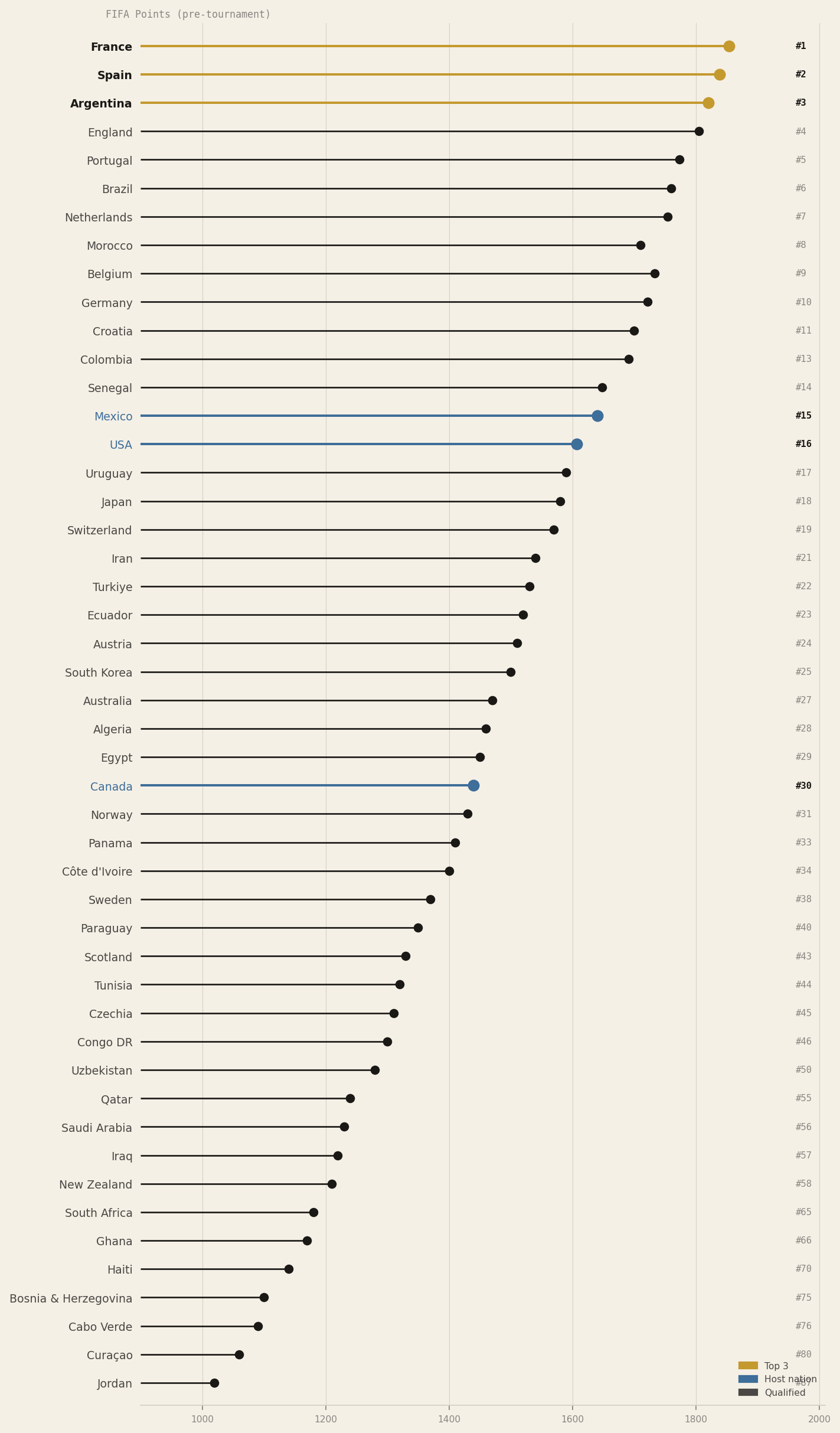
Bars show FIFA points (pre-tournament). Number on the right is each team's world rank. Host nations are highlighted in blue; the top three in gold. Regenerate with python3 analytics/scripts/rankings_chart.py.
Every World Cup final since the tournament began in 1930. Germany's totals include titles won as West Germany (1954 to 1990).
| Year | Winner | Score | Runner Up | Location |
|---|---|---|---|---|
| 1930 | 🇺🇾Uruguay | 4–2 | Argentina | Montevideo, Uruguay |
| 1934 | 🇮🇹Italy | 2–1 + | Czechoslovakia | Rome, Italy |
| 1938 | 🇮🇹Italy | 4–2 | Hungary | Colombes, France |
| 1950 | 🇺🇾Uruguay | 2–1 | Brazil | Rio de Janeiro, Brazil |
| 1954 | 🇩🇪West Germany | 3–2 | Hungary | Bern, Switzerland |
| 1958 | 🇧🇷Brazil | 5–2 | Sweden | Solna, Sweden |
| 1962 | 🇧🇷Brazil | 3–1 | Czechoslovakia | Santiago, Chile |
| 1966 | 🏴England | 4–2 + | West Germany | London, England |
| 1970 | 🇧🇷Brazil | 4–1 | Italy | Mexico City, Mexico |
| 1974 | 🇩🇪West Germany | 2–1 | Netherlands | Munich, West Germany |
| 1978 | 🇦🇷Argentina | 3–1 + | Netherlands | Buenos Aires, Argentina |
| 1982 | 🇮🇹Italy | 3–1 | West Germany | Madrid, Spain |
| 1986 | 🇦🇷Argentina | 3–2 | West Germany | Mexico City, Mexico |
| 1990 | 🇩🇪West Germany | 1–0 | Argentina | Rome, Italy |
| 1994 | 🇧🇷Brazil | 0–0 ^3–2 | Italy | Pasadena, United States |
| 1998 | 🇫🇷France | 3–0 | Brazil | Saint-Denis, France |
| 2002 | 🇧🇷Brazil | 2–0 | Germany | Yokohama, Japan |
| 2006 | 🇮🇹Italy | 1–1 ^5–3 | France | Berlin, Germany |
| 2010 | 🇪🇸Spain | 1–0 + | Netherlands | Johannesburg, South Africa |
| 2014 | 🇩🇪Germany | 1–0 + | Argentina | Rio de Janeiro, Brazil |
| 2018 | 🇫🇷France | 4–2 | Croatia | Moscow, Russia |
| 2022 | 🇦🇷Argentina | 3–3 ^4–2 | France | Lusail, Qatar |
The Schedule
All 104 matches, shown in your local time. Final scores appear once a match has been played; upcoming games show TBD.
Match Recaps
Most recent day first. Each match gets its own tile.
Newest matchday at the top, oldest at the bottom. Each game gets its own tile with goals, key moments, and context.
UPDATED EACH MATCHDAY
Another day where underdogs shaped the tournament. Iran frustrated Belgium in a scoreless draw. Egypt won to tighten Group G. But the biggest storyline was Cape Verde, again. What began as a feel good story after holding Spain scoreless had become one of the defining narratives of the 2026 World Cup. First Vozinha. Now a 2–2 draw against Uruguay. Cape Verde had gone from unknown outsider to one of the most talked about teams on the planet.
Cape Verde did it again. After Vozinha's historic shutout of Spain, the Atlas Lions of the Atlantic earned a dramatic 2–2 draw against Uruguay, a nation that has won the World Cup twice and reached multiple semifinals. Cape Verde came back, matched them, and left the field with a point that sent shockwaves through Group H and through global football culture.
GROUP H · MATCHDAY 2 · 2026 FIFA WORLD CUP
Iran frustrated Belgium in a scoreless draw, continuing the theme of this World Cup: no result is guaranteed, and no team is too big to be held. Belgium had the better chances but couldn't find a way through a disciplined Iranian defensive structure. Another two points dropped for a nation with genuine tournament ambitions.
GROUP G · MATCHDAY 2 · 2026 FIFA WORLD CUP
Egypt delivered their best performance of the tournament so far with a convincing 3–1 victory over New Zealand, tightening the race in Group G and positioning the Pharaohs well heading into the final round. New Zealand had shown fight throughout the tournament but couldn't contain an Egyptian attack that looked far more dangerous than in their opening draw with Belgium.
GROUP G · MATCHDAY 2 · 2026 FIFA WORLD CUP
Japan followed its impressive draw against the Netherlands with a dominant four goal performance that put the rest of Group F on notice. After proving they could hold one of Europe's best, Japan showed they could also destroy opposition when given space, a complete performance that underlined why they are one of the tournament's most dangerous sides.
GROUP F · MATCHDAY 2 · 2026 FIFA WORLD CUP
Spain bounced back from the frustration of being held scoreless by Cape Verde and finally looked like the attacking force many expected entering the tournament. Four goals, no reply, and a performance full of the fluid passing and clinical movement that defines this Spanish generation at its best. The questions from matchday one have been answered, for now.
GROUP H · MATCHDAY 2 · 2026 FIFA WORLD CUP
Day nine saw tournament favorites begin to pull away from the pack, the Netherlands were devastating, Germany ground out a win, and Curaçao wrote another underdog chapter to close the evening. The gap between the established powers and the newcomers narrowed in the final match, but only after the Dutch made clear how wide that gap can still be.
The Netherlands delivered one of the most dominant performances of the group stage, dismantling Sweden 5–1 in a result that immediately established the Dutch as one of the most dangerous teams in the competition. After drawing Japan in their opening match, questions remained about how far the Netherlands could go. Those concerns disappeared quickly as the Dutch attack overwhelmed Sweden from start to finish, turning a matchup between two strong European sides into a statement victory.
GROUP F · MATCHDAY 2 · 2026 FIFA WORLD CUP
Germany continued its march toward the knockout rounds with a hard fought 2–1 victory over Ivory Coast. Unlike their 7–1 opener, Germany was forced to work for every moment against a confident Ivory Coast side. The Germans found the quality needed to secure three points, but Ivory Coast showed enough resilience and attacking threat to suggest they could still influence the race for qualification.
GROUP E · MATCHDAY 2 · 2026 FIFA WORLD CUP
After suffering a 7–1 defeat to Germany in matchday one, many expected Curaçao to struggle again. Instead, the Caribbean nation delivered a disciplined defensive performance to earn its first World Cup point in a 0–0 draw with Ecuador. Combined with Cape Verde's heroics against Spain, Curaçao's result further highlights one of this World Cup's defining themes: smaller nations belong on this stage and are becoming its most compelling stories.
GROUP E · MATCHDAY 2 · 2026 FIFA WORLD CUP
Day eight brought major developments in Groups C and D. The United States moved to six points and the verge of qualification. Paraguay kept its hopes alive. Morocco continued its rise as the tournament's biggest surprise. And Brazil finally produced the dominant performance their talent demanded, though Morocco's story still stole the headlines.
The United States continued its impressive start with a 2–0 victory over Australia, moving to six points and placing itself on the verge of qualification. Australia remained competitive throughout, but the Americans once again demonstrated the balance and discipline that have made them one of the tournament's early success stories.
GROUP D · MATCHDAY 2 · 2026 FIFA WORLD CUP
Paraguay kept its knockout round hopes alive with a crucial 1–0 victory over Turkey, ensuring Group D would remain competitive heading into the final round of matches. Turkey, who had already lost to Australia in matchday one, now face a very difficult path forward. Paraguay's win means three teams could still theoretically advance.
GROUP D · MATCHDAY 2 · 2026 FIFA WORLD CUP
Morocco continued to emerge as one of the tournament's biggest surprises with a hard fought 1–0 victory over Scotland. Moving to four points, the result confirmed that their opening draw against Brazil was no fluke. Once again Morocco's defensive organization and ability to frustrate opponents proved decisive, Scotland was left searching for answers after failing to find a breakthrough.
GROUP C · MATCHDAY 2 · 2026 FIFA WORLD CUP
Brazil finally produced the type of performance many fans had been waiting for, a convincing 3–0 victory over Haiti that eased the growing concerns following their opening draw against Morocco. The result reminded everyone why they remain one of football's most talented squads. Yet despite Brazil's dominant win, Morocco's continued success remained the bigger story of the day.
GROUP C · MATCHDAY 2 · 2026 FIFA WORLD CUP
Mexico took a major step toward the knockout rounds with a narrow 1–0 victory over South Korea in one of the most important matches of Group A. Both teams entered after opening round victories, meaning the winner would move into a commanding position in the race for qualification. While Mexico ultimately earned all three points, the performance left many supporters feeling more relieved than convinced, South Korea matched Mexico for long stretches, remained organized defensively, and created enough to suggest the result could have easily gone the other way.
Hail Mary Celebration · YouTube Short
GROUP A · MATCHDAY 2 · 2026 FIFA WORLD CUP GROUP STAGE
One of the first major surprises of day seven came when Portugal was held to a 1–1 draw by DR Congo in Group K. Entering as one of Europe's most talented squads and widely expected to begin with a victory, Portugal instead ran into a determined and organized performance that frustrated them for long stretches and proved DR Congo belonged on the same stage as one of football's traditional powers.
GROUP K · 2026 FIFA WORLD CUP GROUP STAGE
Ghana secured a hard fought 1–0 win over Panama in Group L, relying on defensive discipline and patience to earn all three points. Panama remained competitive throughout and threatened on several occasions, but Ghana's organization and experience ultimately proved decisive.
GROUP L · 2026 FIFA WORLD CUP GROUP STAGE
Colombia delivered a more attacking display with a 3–1 victory over Uzbekistan in Group K. Uzbekistan showed why its qualification was one of the region's great football stories and managed to find the back of the net, but Colombia's quality was evident throughout, controlling possession, creating the better opportunities, and consistently looking dangerous in the final third.
GROUP K · 2026 FIFA WORLD CUP GROUP STAGE
England and Croatia delivered one of the most entertaining matches of the tournament's opening round, combining for six goals in a thrilling 4–2 English victory. The matchup carried extra intrigue given their recent history, most notably Croatia's dramatic semifinal victory over England at the 2018 World Cup. This time, England controlled much of the action and showcased the attacking depth that has many supporters dreaming of a deep tournament run.
GROUP L · 2026 FIFA WORLD CUP GROUP STAGE
France opened its 2026 World Cup campaign with a 3–1 victory over Senegal in a match that carried far more history than a typical group stage opener. The meeting immediately brought back memories of the 2002 World Cup, when Senegal shocked the football world by defeating defending champion France 1–0 in one of the greatest upsets in tournament history. Twenty four years later, the two nations met again on football's biggest stage, France seeking redemption, Senegal hoping to author another memorable chapter.
GROUP I · 2026 FIFA WORLD CUP GROUP STAGE
Norway delivered a commanding 4–1 victory over Iraq in their first World Cup match since 1998, ending a 28 year absence from football's biggest stage. Led by Erling Haaland, Norway overwhelmed Iraq with pace, power, and clinical finishing. The long wait made the celebration that much louder.
Viking Row · YouTube Short
GROUP I · 2026 FIFA WORLD CUP GROUP STAGE
Argentina. Three goals. Zero conceded. That's what Argentina does. They controlled possession, dictated the tempo, and barely broke a sweat doing it. This is a team that knows exactly who it is, world champions, and comfortable reminding everyone of that fact from the very first match.
GROUP J · 2026 FIFA WORLD CUP GROUP STAGE
Day five of the World Cup produced one of the most unusual and memorable sets of results in recent tournament history. All four matches ended in draws, yet the action was anything but uneventful. Spain were held to a shocking 0–0 by Cape Verde, Belgium and Egypt shared the points 1–1, Saudi Arabia earned an impressive draw against Uruguay, and Iran and New Zealand closed the evening with a 2–2 thriller. No team managed to secure all three points, but every match delivered its own story.
The bigger story: nations once considered outsiders repeatedly challenging established football powers. There are no easy matches at this World Cup.
The headline result of day five. Spain entered as a former world champion and heavy favorite, hoping to manage minutes ahead of tougher fixtures. Instead they ran into one of the tournament's most inspiring individual performances, 40 year old goalkeeper Vozinha, who repeatedly denied Spanish attackers and set a new World Cup record for the most saves ever recorded in a scoreless match.
GROUP H · 2026 FIFA WORLD CUP GROUP STAGE
Egypt proved it could stand toe to toe with Belgium in a hard fought 1–1 draw. Belgium had the pedigree and the star quality, but Egypt matched them in intensity and organization, earning a well deserved point that signals they are not here simply to make up the numbers.
GROUP G · 2026 FIFA WORLD CUP GROUP STAGE
Saudi Arabia continued its reputation for upsetting expectations, earning an impressive 1–1 draw against Uruguay. The South Americans are a seasoned tournament side, but Saudi Arabia matched them for effort and quality across the ninety minutes, taking a point that reinforces their growing status in world football.
GROUP H · 2026 FIFA WORLD CUP GROUP STAGE
Iran and New Zealand closed day five with the highest scoring match of the evening, exchanging goals in an entertaining 2–2 contest. New Zealand, one of the tournament's smaller football nations, showed the kind of attacking ambition and belief that the expanded World Cup format was designed to showcase. Iran had the experience but couldn't hold on for a win.
GROUP G · 2026 FIFA WORLD CUP GROUP STAGE
Ivory Coast opened its World Cup campaign with a narrow but important 1–0 victory over Ecuador in Group E. In a match where chances were limited and neither side was willing to take unnecessary risks, the African champions demonstrated patience and discipline to secure all three points. Ecuador remained competitive throughout and threatened on several occasions, but Ivory Coast's defense held firm when it mattered most.
GROUP E · 2026 FIFA WORLD CUP GROUP STAGE
Sweden delivered one of the most dominant performances of the tournament's opening round, defeating Tunisia 5–1 in a commanding Group F display. Sweden's attack was relentless from start to finish, overwhelming Tunisia with quick passing, clinical finishing, and constant pressure in the final third. While Tunisia managed to find a goal, the result was never seriously in doubt.
GROUP F · 2026 FIFA WORLD CUP GROUP STAGE
Scotland opened its 2026 World Cup campaign with a hard fought 1–0 victory over Haiti in a match that was far closer than many expected. While Scotland ultimately secured all three points, Haiti showed throughout the evening that they were more than capable of competing on football's biggest stage, defending with discipline, matching Scotland's physicality, and creating several moments that kept the outcome uncertain until the final whistle.
GROUP C · 2026 FIFA WORLD CUP GROUP STAGE
Australia claimed a confident 2–0 win over Turkey to open their Group D campaign, pairing up with the USA's big opening night result to make Group D one of the early tournament's most impressive performing groups. The Socceroos were composed and direct, controlling the match to secure a result that positions them strongly for the knockout stage race.
GROUP D · 2026 FIFA WORLD CUP GROUP STAGE
Germany sent an immediate statement of intent with a ruthless 7–1 demolition of Curaçao on matchday one. The scoreline was emphatic and the performance was relentless, Germany pressed from the opening minutes, created chance after chance, and finished with clinical precision. It was exactly the kind of opening performance that signals a team arriving at a tournament in form.
Highlights · YouTube Short
GROUP E · 2026 FIFA WORLD CUP GROUP STAGE
The Netherlands and Japan played one of the most entertaining matches of the tournament's opening week, battling to a 2–2 draw in a result that felt far more significant for Japan than for their European opponents. Many expected the Dutch to control proceedings, but Japan once again demonstrated why it has become one of the most respected teams outside football's traditional powers, matching the Netherlands goal for goal and refusing to back down under pressure.
Fan Moment · YouTube Short
GROUP F · 2026 FIFA WORLD CUP GROUP STAGE
One of the biggest surprises of the tournament's opening week came when Morocco held Brazil to a 1–1 draw in Group C. On paper, Brazil entered as one of the favorites to win the World Cup, carrying the weight of five world titles and a reputation for attacking brilliance. Yet for long stretches of the match, it was Morocco that looked like the more confident and organized side, pressing aggressively, controlling key moments in midfield, and repeatedly disrupting Brazil's rhythm.
Highlights · YouTube Short
GROUP C · 2026 FIFA WORLD CUP GROUP STAGE
Qatar and Switzerland played to a hard fought 1–1 draw, producing another tightly contested battle in the opening days of the World Cup. A win would have placed either side alone at the top of the group, instead, neither could find a decisive breakthrough, leaving Group B perfectly balanced after the first round.
GROUP B · 2026 FIFA WORLD CUP GROUP STAGE
The opening match in Group B saw Canada and Bosnia and Herzegovina battle to a 1–1 draw in front of an energetic home crowd. As a co host nation, Canada entered carrying high expectations but Bosnia proved a difficult opponent, matching their intensity and organization throughout the ninety minutes. Both sides created opportunities in an evenly contested match that highlighted the competitive nature of the expanded World Cup field.
GROUP B · 2026 FIFA WORLD CUP GROUP STAGE
The United States delivered one of the most impressive performances of the tournament's opening week with a commanding 4–1 victory over Paraguay. Playing in front of a passionate home crowd, the Americans attacked with confidence and pace, overwhelming Paraguay for long stretches. The four goal display immediately announced the US as a serious contender in Group D.
GROUP D · 2026 FIFA WORLD CUP GROUP STAGE
The second match of the 2026 FIFA World Cup brought together South Korea and Czechia in a contest that quickly demonstrated how competitive Group A would be. South Korea earned a hard fought 2–1 win to join the hosts atop the group standings. Both teams entered the match seeking an early advantage in the race for qualification, creating an intense atmosphere despite it being only the first round of group play.
Highlights · YouTube Short
MATCH 2 OF 104 · 2026 FIFA WORLD CUP GROUP STAGE
Mexico opened its 2026 FIFA World Cup campaign with a memorable 2–0 victory over South Africa in front of a roaring home crowd at Estadio Azteca. The tournament's first match carried enormous expectations, and El Tri delivered from the opening minutes. Mexico controlled possession throughout, creating chances and dictating the pace while South Africa struggled to establish sustained attacking pressure. The victory marked an ideal beginning for the host nation.
MATCH 1 OF 104 · 2026 FIFA WORLD CUP GROUP STAGE
Performances
Beyond the action on the field, the 2026 FIFA World Cup will make history by introducing the tournament's first ever halftime show during the Final on July 19. The addition reflects FIFA's effort to further elevate the event as both a sporting competition and a global entertainment showcase.
The 2026 FIFA World Cup Final will introduce a historic first: a halftime show. Scheduled for July 19 at New York New Jersey Stadium, the event is expected to feature performances by Madonna, Shakira, and BTS, with creative direction from Chris Martin of Coldplay. The show will also help support the FIFA Global Citizen Education Fund, which aims to raise $100 million to improve access to education and football programs for children around the world.
JULY 19 · NEW YORK NEW JERSEY STADIUM · LIVE BROADCAST WORLDWIDE
Before the first ball was kicked, Estadio Azteca set the stage for the 2026 FIFA World Cup with a celebration of Latin America's musical heritage. The opening ceremony featured a blend of rock, ranchera, cumbia, and reggaeton, honoring both legendary performers and contemporary artists while welcoming the world to Mexico for football's biggest tournament.
JUNE 11 · BEFORE MEXICO VS SOUTH AFRICA
Before Canada's first-ever home FIFA World Cup match, BMO Field hosted an opening ceremony centered on the theme of a "cultural mosaic." The celebration showcased Canada's multicultural identity through music and performances representing communities from across the country.
JUNE 12 · BEFORE CANADA'S HOME OPENER
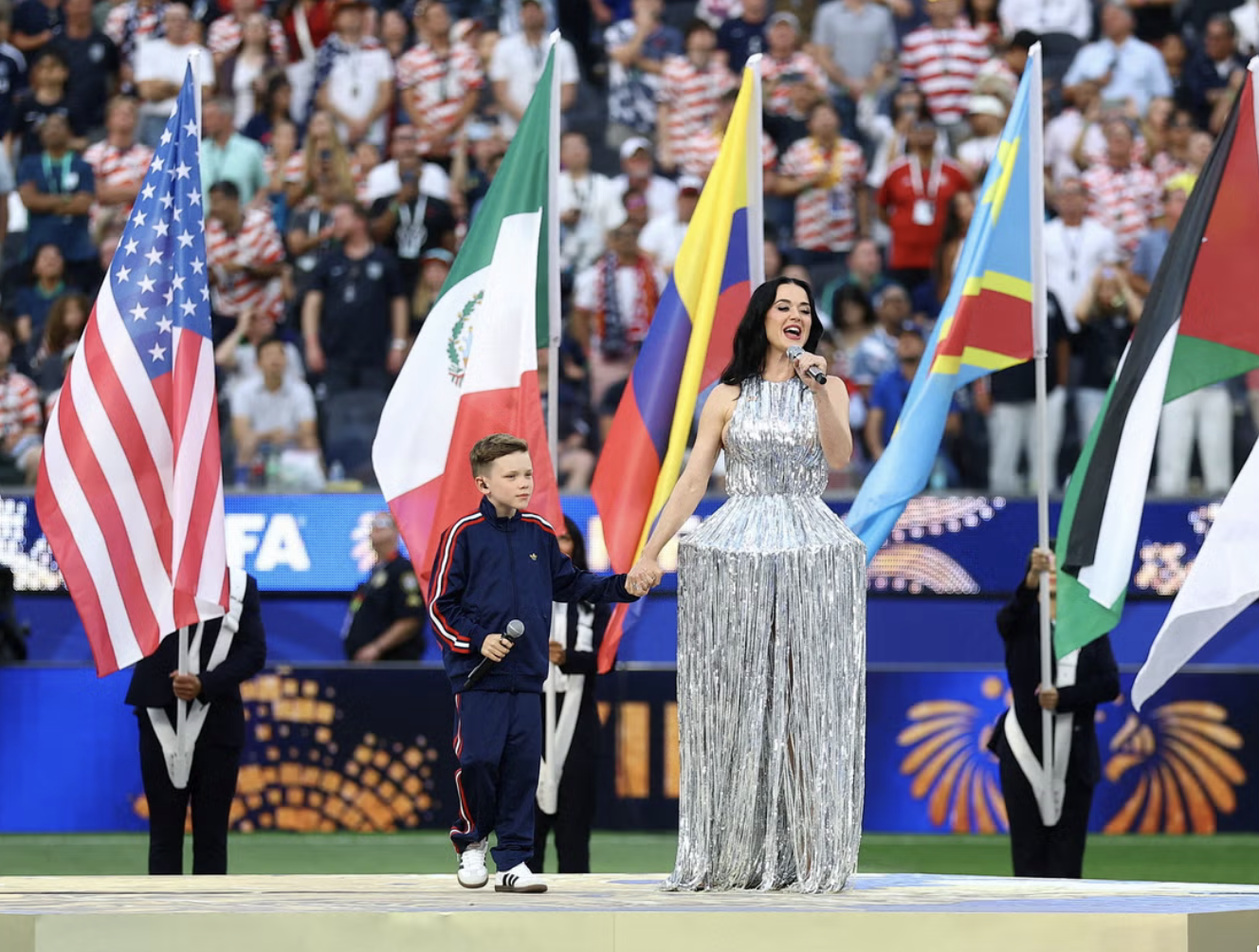
The United States opening ceremony brought together artists from across pop, hip-hop, Afrobeats, and K-pop, reflecting both the country's cultural diversity and the global nature of the FIFA World Cup. The performance blended music, storytelling, and stadium-scale visuals to welcome fans from around the world.
FIFA announced the first ever FIFA World Cup Final Halftime Show, bringing music and football together on the world's biggest sporting stage.
Watch the official FIFA World Cup 2026™ Final Halftime Show announcement.
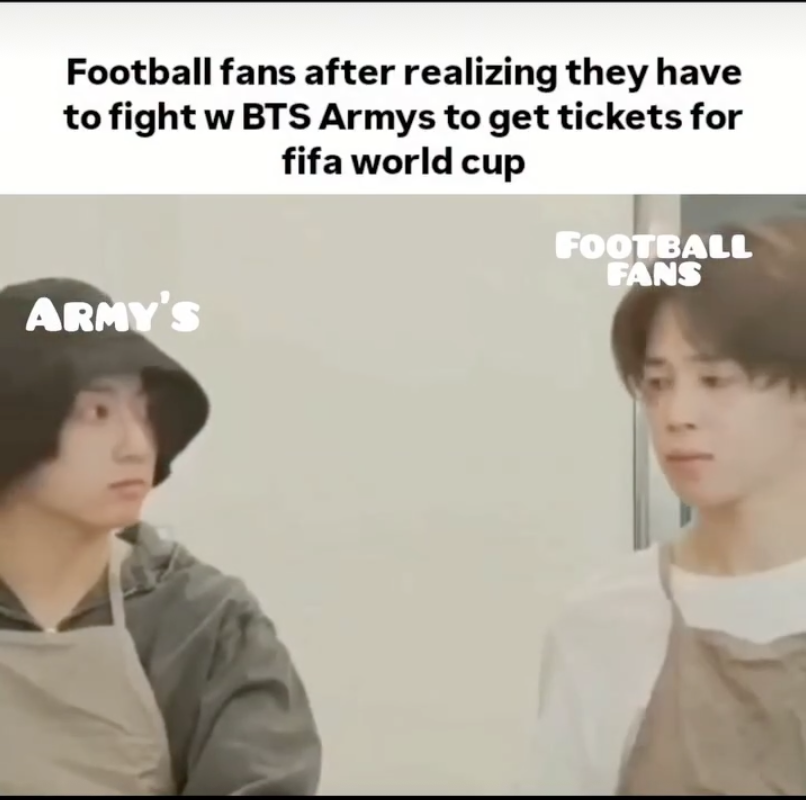
The announcement of the first ever FIFA World Cup Final Halftime Show immediately captured global attention. When BTS was revealed as the headliner, social media filled with excitement, predictions, and memes as BTS fans and football fans collided online in one of the tournament's most unexpected storylines.
Who is BTS? →